Overleaf AI now a part of Overleaf plans
July 2, 2026Overleaf AI is now included in all Overleaf plans at no extra cost, with usage allowances and features varying by plan type. We’re also introducing Commons AI as a new option to increase the Overleaf AI allowance for campus-wide subscriptions.
This is because our most recent product survey indicates that 81.6% of you use AI in your research work or studies, and 60% use AI for LaTeX support. So now that assistance is available inside Overleaf: no context or window switching and with custom prompts tailored to research and technical writing.
This post breaks down exactly what's available on each plan, what the daily allowances mean in practice, and what's different for universities with the introduction of Commons AI.
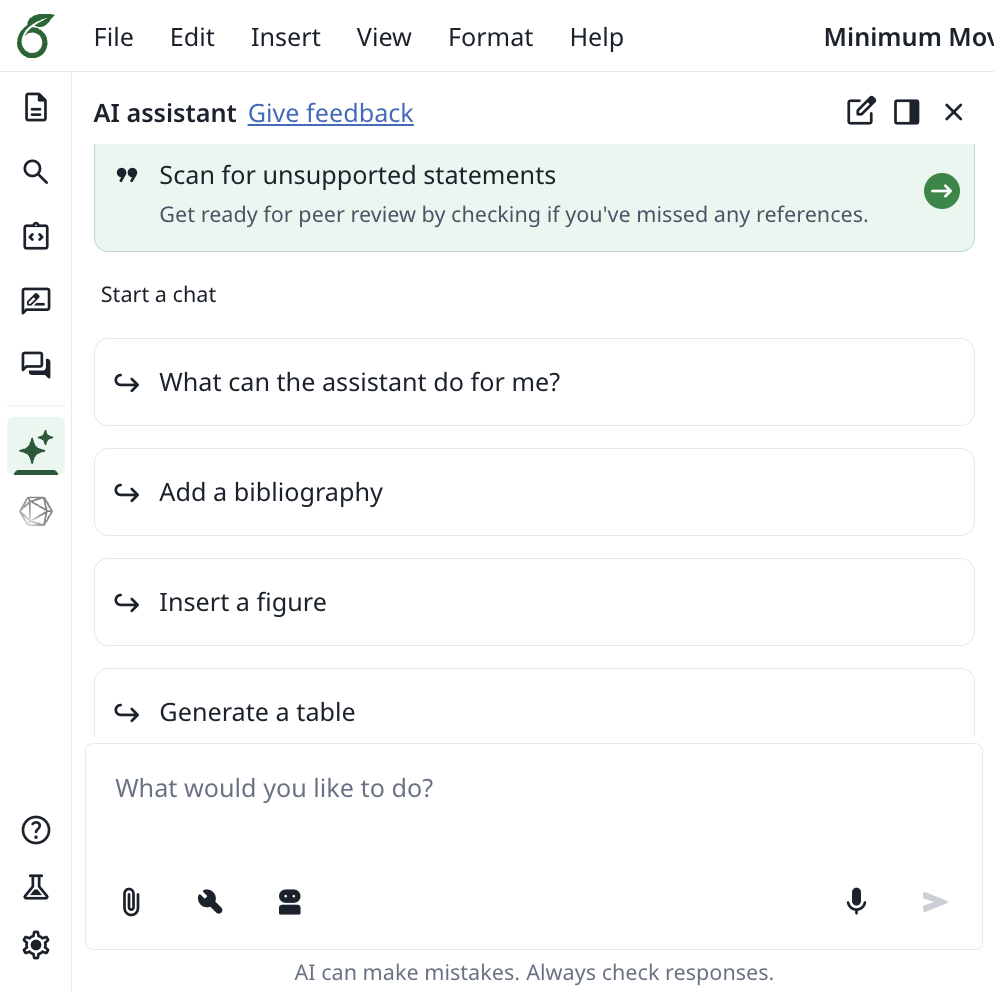
How Overleaf AI works
Overleaf AI is the umbrella name for all of Overleaf's built-in AI tools. These include:
- Error Assist: Explains LaTeX compile errors in plain language and suggests fixes, directly in the editor
- AI Assistant: A chat-based tool for getting help with LaTeX, improving your writing, generating code for tables and equations, paraphrasing, and more
- Citation Reviewer: Scans your document for unsupported claims and suggests relevant papers, sourced from Dimensions to prevent hallucinated references (Note: This applies only to the “Scan for unsupported statements” tool. Prompts written in the chat will be generated by an LLM.)
- Language tools: Including Paraphrase and Make scientific, for refining academic English without changing your meaning
More details are in our documentation or check out our Overleaf Learning course: Leveraging Overleaf AI.
What each plan includes
Free
Basic without AI Assistant: Enough for the occasional assist: fix an error, check a formula, or get unstuck when you need it most. For most users who are occasionally writing in Overleaf, the Basic allowance covers the moments where you hit a wall and need a hand.
Student
Basic allowance with AI Assistant: The Student plan has the same daily allowance as Free, but it includes the AI Assistant. That matters if you're writing a thesis or a journal submission and you need more than error fixes. The AI Assistant handles LaTeX questions in plain language, generates code for complex tables and equations, reviews your citations, and helps polish academic prose.
Standard
Standard allowance: Enough for most researchers and writers. Use it to catch errors, tidy formatting, and sharpen your writing throughout the day.
Standard includes the AI Assistant with a higher allowance relative to Student. If you’re working through a paper across several days, running Citation Reviewer before submission, cleaning up language between drafts — it covers a typical writing session comfortably.
Pro
Max AI allowance: Use AI as much as you like. Just write, and let Overleaf handle the rest. Fair usage applies. Pro is for researchers who write in Overleaf heavily and often: grant applications, multiple concurrent papers, or long documents with lots of LaTeX.
What's new: Commons AI for institutions
Overleaf Commons subscriptions have the Basic allowance with no AI Assistant. Overleaf Commons AI is a new institutional subscription tier that gives everyone at a university the Max allowance — unlimited AI usage within fair use — plus the AI Assistant. This is the same capability as a Pro subscription, covered by one institutional subscription.
In practice, that means:
- Every researcher at the institution gets Error Assist, the AI Assistant, Citation Reviewer, and all language tools, without needing a personal paid plan
- No daily limit on AI usage: researchers can use Overleaf AI throughout their writing sessions without rationing
- Billing and user management stay centralized: there’s no patchwork of subscriptions to administer
- User data is never used to train AI models without explicit consent, as with all Overleaf plans
A note on data and AI principles
Across all plans, Overleaf AI is built on three principles: supporting humans rather than replacing them, supporting academic integrity rather than undermining it, and respecting user privacy and confidentiality.
User content is never used to train AI models without explicit consent. Citation recommendations are sourced from Dimensions, the world's largest database of interconnected research, which means suggestions are grounded in real, published papers rather than generated by the model.
Where to go from here
If you're on a Free plan and hitting the daily limit, there are multiple plan options to increase your daily AI allowance that fit your needs.
If you're at a university or research institution on a standard Overleaf Commons subscription, talk to your library or IT team about Commons AI, or contact Overleaf directly to find out what an upgrade would look like for your institution.